Wells Fargo continues to meet clients' sustainability needs
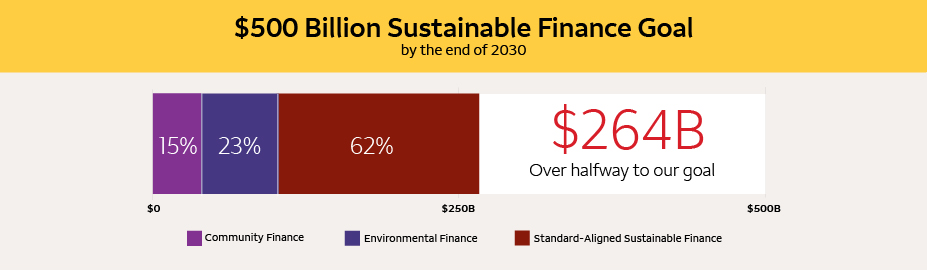
Since 2021, the bank has financed and facilitated $264 billion toward its 2030 $500 billion sustainable finance goal.

by Jeffrey Schub, head of sustainability at Wells Fargo
November 5, 2025
4-minute read
Today's business leaders across a broad range of sectors are navigating many sustainability-related challenges and opportunities. Federal policy, regulations, and the tax code are changing. Energy, housing, and resilience needs are growing while affordability constraints increase. New electricity-driven technologies like electric vehicles and data centers are poised to change the power grid. These factors point to new capital needs that are larger in scale and rely on smart financial support.
Many corporate decision-makers see business value in investing in renewable energy, clean transportation, water management, affordable housing, and economic development. At Wells Fargo, bankers support clients to help them unlock that business value by meeting their sustainability-related financing needs.
In 2024, the bank had a record year, financing and facilitating $87 billion of sustainable finance. That brings the total to $264 billion since 2021 when Wells Fargo announced its $500 billion sustainable finance by 2030 goal — which is now more than halfway to the target.
Strategic investment is driving impacts in the real economy
This momentum is fueled by clients in areas where Wells Fargo has deep expertise and a strong track record as a financial partner. In the energy sector, the bank continues to invest in and finance renewable energy through its growing project finance business and tax equity investment group. At the same time, affordable housing also remains a focus, backed by Low-Income Housing Tax Credit investments, affordable housing lending, and loan originations through government-sponsored enterprise partners.
Over the last year, Wells Fargo's clients also demonstrated increased interest in labelled sustainable finance products, including those that fund sustainable activities or provide incentives tied to their own sustainability goals. Bond underwriting for development banks supporting positive environmental and social outcomes around the world increased. The bank's equipment finance activity also grew, driven largely by electrified equipment and vehicles.
These trends reflect a stronger alignment between clients' sustainability objectives and their long-term business needs. It also reinforces Wells Fargo’s important role in delivering the financing clients need to drive resilient and forward-looking solutions in the real economy.
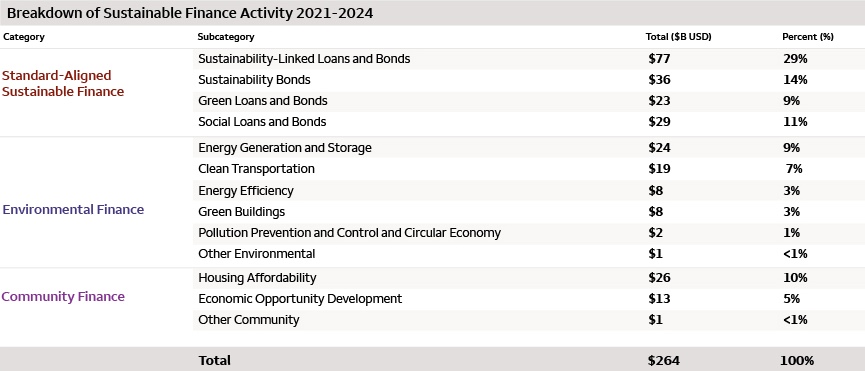
Due to rounding, the numbers presented may not add up precisely.
Renewable energy in a changing landscape
Wells Fargo has leading capabilities in the power sector, helping developers and utilities source the capital they need to meet the nation's growing energy demand. Much of this demand is now coming from data centers. Across the electricity sector, renewable energy sources are becoming increasingly cost-effective and readily available.
The Renewable Energy & Environmental Finance (REEF) team remains a leader in tax equity financing, investing more than $20 billion in renewable energy projects across nearly 40 states since 2006. These transactions are helping to deploy clean energy and storage technologies.
In addition to tax equity, the bank also leads debt-based transactions for renewable developers. An innovative deal enabled a leading renewable developer to directly access capital markets in order to fund the construction of six fully contracted wind, solar, and battery storage projects without relying on intermediary financing structures.
But energy sector activity goes beyond pure renewable energy developers. Wells Fargo is helping utility clients that have historically relied on fossil fuels raise capital to pursue long-term investments in renewable power and battery storage as part of balanced and flexible capital plans to meet their own customer needs.
As data center growth and the use of artificial intelligence further drive energy needs, Wells Fargo's commercial real estate business is leveraging its expertise in labelled sustainable transactions, which help direct capital to green building projects, renewable power sources, and high-efficiency technologies. For example, last year Wells Fargo led a $3 billion green loan facility for a leading data center developer.
The power sector is entering a complex moment. As power demand and costs grow, clients and investors are relying on partners who understand how to successfully navigate changing policy and regulations. Wells Fargo’s client focus and expertise across many aspects of sustainable finance shows the bank is well positioned to continue making progress toward its $500 billion sustainable finance goal while meeting market needs.